Physics

Laboratory

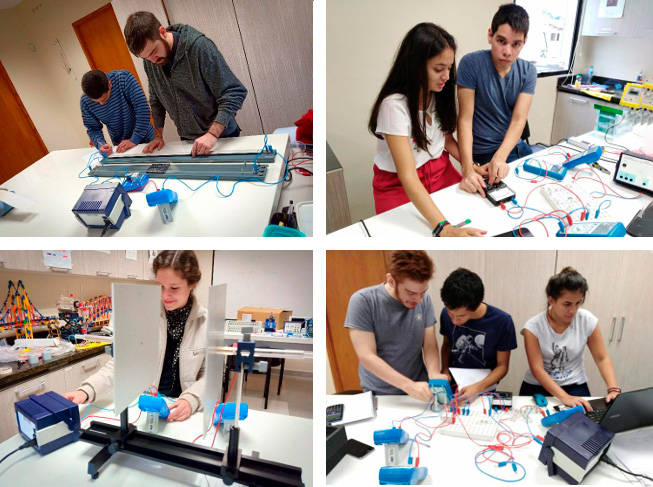
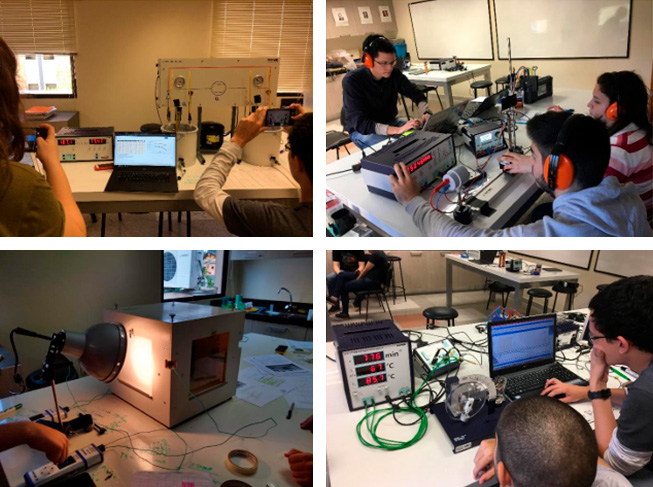
The Physics Laboratory is a space where theoretical concepts are complemented by hands-on practice. Here, experimental techniques related to physics are taught, providing technical support to the Industrial Engineering and Civil Engineering programs in subjects such as Physics, Strength of Materials, and Concrete, among others.

Laboratory Objectives

  • Conduct and validate scientific experiments.
  • Teach advanced experimental techniques.
  • Promote scientific perspectives among students of the Faculty of Engineering Sciences.
01

Fields of Application

  • Newtonian Mechanics
  • Energy
  • Thermodynamics
  • Waves
  • Electricity
  • Magnetism
  • Concrete Properties
  • Stress Analysis in Materials
02

Experiments and Activities Newtonian Mechanics and Energy

Students have the opportunity to carry out the following experiments:

  • Measurements of length, mass, and time.
  • Experimental verification of vector calculations using the Force Table, representing vectors in magnitude, direction, and sense.
  • Study of parabolic motion, constant and instantaneous velocities, and acceleration in linear motion and free fall.
  • Determination of the relationship between static force on an inclined plane, the angle of inclination, and the coefficient of static friction of various materials.
  • Analysis of linear dynamics and dynamics on an inclined plane to study Newton’s Second Law and verify the equation of motion in uniformly accelerated rotations.
  • Experiments on work, energy, and collisions: verification of Hooke’s Law, conservation of momentum before and after elastic and inelastic collisions, and verification of the Law of Conservation of Energy.
03

Thermodynamics and Waves

In this section, students can:

  • Verify heat transfer mechanisms, calorimetry, and phase changes.
    Analyze how fluid density varies as a function of temperature.
  • Determine overall heat transfer coefficients and establish the thermal conductivity values of different materials.
  • Study frictional heating of a rotating metal body using a tensioned synthetic material belt, determining the mechanical equivalent of heat and the specific heat capacity of aluminum and brass.
  • Measure pressures, temperatures (of water and refrigerant), power, and energy consumption over time to study the vapor compression refrigeration cycle.
  • Demonstrate the periodicity of stationary oscillators connected by a continuous transverse harmonic wave generated by the wave machine.
  • Analyze the Doppler effect when the sound source or detector moves relative to the propagation medium.
  • Apply steam distillation to separate organic substances that are insoluble in water and slightly volatile from non-volatile substances present in the mixture, such as resins or inorganic salts.
04

Electricity and Magnetism

In the laboratory, the following experiments can be conducted:

  • Experimentally verify electric field lines between electrodes and confirm that they are orthogonal to equipotential lines.
  • Determine the relationship between voltage and current in a circuit.
    Identify and evaluate total resistance, voltage, and current in series and parallel circuits.
  • Verify Kirchhoff’s current and voltage laws.
    Establish the relationship between resistance and capacitance with respect to the charging and discharging time of a capacitor.
  • Examine the magnetic phenomenon in a current-carrying conductor and understand the concepts of magnetic field.
  • Determine the magnetic field produced by a pair of circular, parallel coils.
  • Explore the characteristics and applications of electromagnetic induction.
  • Investigate the effects of self-induction in direct current circuits, among other phenomena.

Available Equipment

The UPA Physics Laboratory is equipped with the following instruments, among others:

  • Doppler Effect and Wave Machines.
  • Electricity and Magnetism Kits.
  • Mechanics Kits.
  • Renewable Energy Kits.
  • Stirling Engine.
  • Basic Constants
  • Measurement Apparatus.
  • Air Track and Air Generator.
  • Variable gravity, ballistic, and mathematical pendulums.
  • Free-fall apparatus.
  • Friction measuring apparatus.
  • Maxwell’s Wheel and accessories.
  • Heat pump.
  • Thermodynamics and calorimetry kits.