The Industrial Engineering degree provides comprehensive training covering key content in Logistics and Supply Chain, as well as in the area of Machinery, aligned with the demands of the productive and industrial environment.
In addition to a solid technical foundation, the program promotes the development of professional competencies through practical exercises and interdisciplinary projects focused on solving real-world problems in industrial contexts, both individually and in team-based settings.
Graduates are expected to have solid technical engineering knowledge as well as a sound understanding of business management in order to bridge the gap between these two disciplines. In addition to the technical skills acquired, graduates of the Industrial Engineering program will also achieve a high level of language proficiency.
Graduates will be able to handle tasks across multiple areas thanks to a broad technical and economic foundation acquired through basic training. Practical relevance is achieved through the completion of numerous research projects, which are inspired and promoted directly by industrial companies. In addition, industry internships and the thesis address current challenges and explore innovative topics. Close collaboration with project partners creates opportunities to directly integrate current developments and real-world challenges into the teaching process. In this way, a forward-looking and practice-oriented education is ensured.
The professional field of an Industrial Engineer with a Master’s degree ranges from strategic operations management and the management of manufacturing and service plants to the optimization of global supply chains, intelligent process automation, and consulting in productivity and quality. These professionals work in both public and private sectors, in national or multinational companies across industries such as chemicals, plastics, metalworking, food production, and logistics, or they may pursue their own technological innovation ventures—always with a vision focused on sustainable efficiency and multidisciplinary leadership.
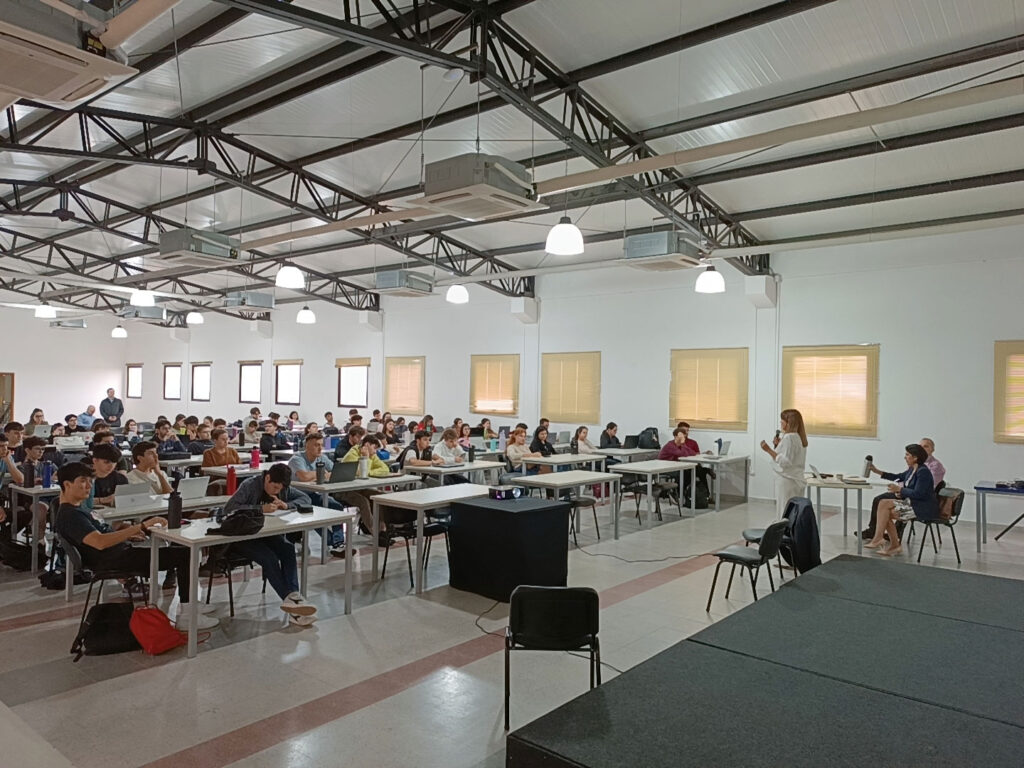
This profile responds to the demands of the labor market in Germany and Paraguay, according to a market study conducted by the two founding institutions of the Universidad Paraguayo Alemana: SRH Holding and the Paraguayan Industrial Union.
To achieve this profile, the program has a duration of eight semesters and applies a competency-based education model: Competency Oriented Research and Education (CORE), developed by SRH Holding.
The degree program lasts ten semesters, of which eight semesters are completed on the campus of the Universidad Paraguayo Alemana and two semesters at SRH Holding in Germany. The course content is based on the SRH Heidelberg program and complies with ANEAES quality criteria, adapted to the context of Paraguay’s business environment.
The main components of the program include:
Academic subjects offered in five-week blocks aimed at developing the logical and cognitive foundations that support learning at the academic level. These include courses such as Calculus, Physics, Chemistry, Introduction to Computing, Theory of Knowledge, among others.
Engineering-related subjects are offered in five-week blocks to develop technical and human competencies in the fields of Industrial Engineering and Civil Engineering. Most of these courses are completed in Paraguay, while three courses are taken in Germany as Professional Electives. The subjects are organized into various thematic areas such as Production, Logistics, Quality Control, Industrial Facilities, Strength of Materials, Fluid Mechanics, Thermodynamics, Vector Mechanics, Innovation Management, Topography and Mapping, Hydrology, Structural Analysis, Concrete, among others.
The German language is offered with a focus on developing language skills and intercultural competence, identified as business communication. These classes are offered six hours per week during the first five semesters of the program.
The program offers an internship in Germany lasting four to six months, with the aim of applying the competencies acquired in an international context. This internship is accompanied by intensive support from the International Office of SRH Heidelberg.
At the end of the seventh semester, students in the Industrial Engineering program carry out an experience exchange project, which leads to the awarding of the German Bachelor’s degree.
In the ninth semester, the student completes the program with the defense of a thesis in Paraguay. The thesis preparation is supported by a UPA thesis mentor and includes follow-up workshops and peer exchange sessions throughout the final semester of the program. For students of both Industrial Engineering and Civil Engineering, this work leads to the awarding of the Engineer degree in Paraguay.
For Industrial Engineering students, this work also leads to the German Master’s degree.
Do you want to study at UPA? Fill out the form and we will get in touch with you.
"(Required)" indicates required fields